Project Details
Home/Project Details
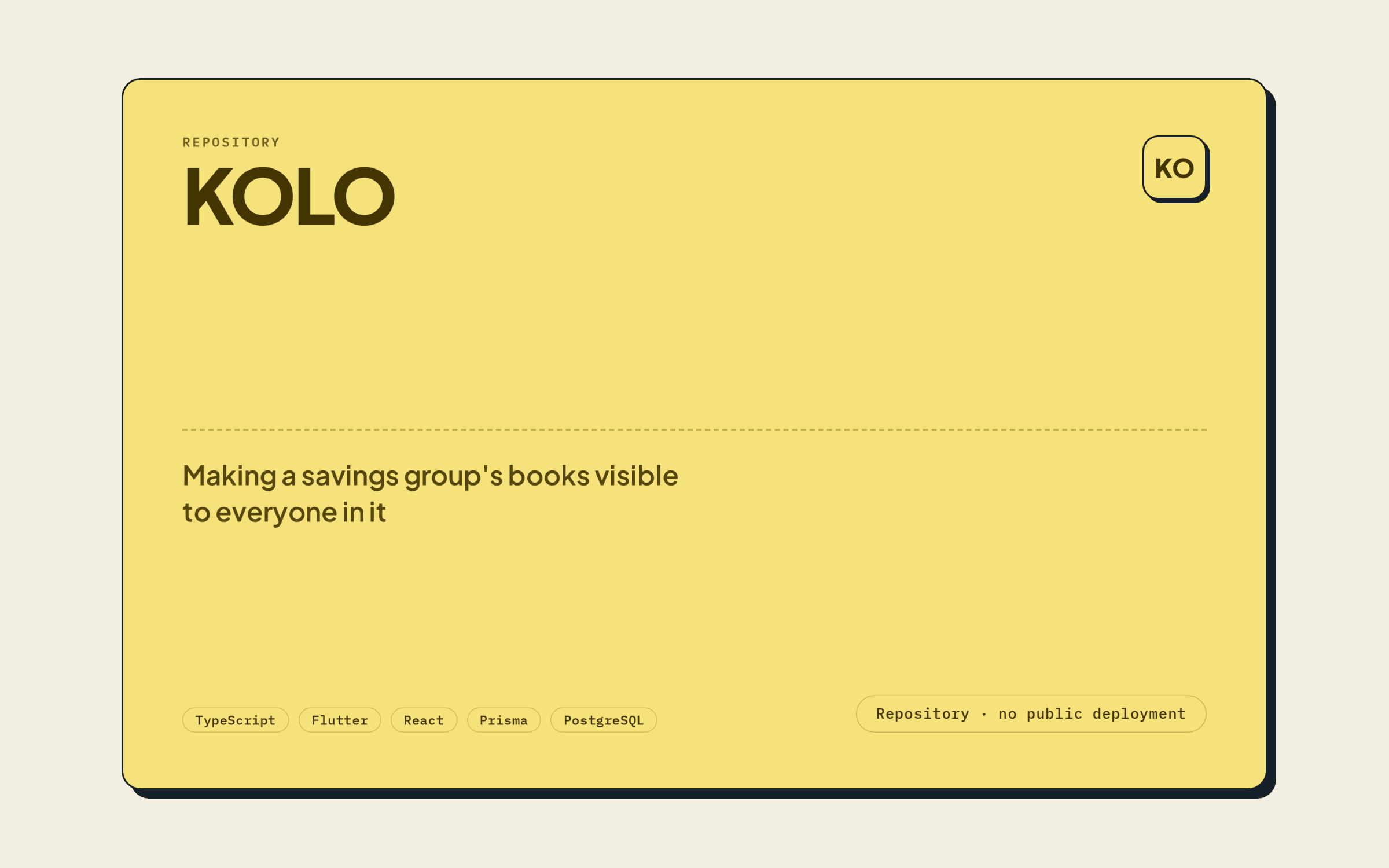
KOLO
Project description
Making a savings group's books visible to everyone in it
The Challenge
Nigerian cooperative savings groups — ajo, esusu, kolo — run on trust and a notebook. Contributions are recorded by hand, membership changes by word of mouth, and when money goes missing the group has no record to point at, only a disagreement between people who have to keep living near each other.
The system cannot assume the group is adversarial — most of the time everyone is acting in good faith, and a product that treats treasurers as suspects will not be used. But when something does go wrong, the record has to be complete enough to settle it without a confrontation.
The Solution
A shared ledger that every member can see, on the principle that transparency prevents the dispute rather than resolving it: contributions, withdrawals and balances are visible to the group, and any correction is an entry rather than an edit. Membership and cycle rules are modelled explicitly, because that is where informal groups actually break — a person leaves mid-cycle and nobody can reconstruct what they owed.
Skills and deliverables
Features delivered
The hard part
Modelling an informal group without legislating it. Real cooperatives have rules that vary by group and change by agreement, so the model has to be configurable without becoming a rule engine the treasurer has to be trained on.
The Impact
A designed and partially built system, with the ledger and transparency model worked out. It is a concept in the repository rather than a running service, and the record says that.